
Blog
The UBI Debate: New Pilots, Economic Modeling, and the Role of UBI in an Automated Economy**


The concept of Universal Basic Income (UBI) has gained significant attention in recent years, particularly with the rise of automation and its potential to displace jobs. As technology advances, the debate surrounding UBI has intensified, with proponents arguing it could be a safety net for those losing their jobs to machines.
New UBI pilot programs are being launched worldwide to test the feasibility of implementing such a system. These programs, along with advanced economic modeling, aim to understand the potential impacts of UBI on society and the economy.
The role of UBI in an automated economy is complex, involving considerations of economic sustainability, social welfare, and the future of work. As the debate continues, it’s crucial to examine the evidence from pilot programs and economic analyses.
Key Takeaways
- The debate around UBI is intensifying due to automation.
- New pilot programs are testing UBI’s feasibility.
- Economic modeling is crucial for understanding UBI’s impact.
- UBI could serve as a safety net for job losses.
- The future of work is a key consideration in the UBI debate.
What Is Universal Basic Income (UBI)?
Universal Basic Income (UBI) is an emerging idea that proposes providing every citizen with a regular, unconditional sum of money. This concept has garnered significant attention in recent years due to its potential to address issues related to poverty, inequality, and the challenges posed by automation in the job market.
Core Principles and Definition
At its core, UBI is designed to be a universal and unconditional benefit. It means that every individual is entitled to receive a basic income, regardless of their employment status or any other factors. The idea is to provide a safety net that ensures a minimum standard of living. As Andrew Yang, a proponent of UBI, notes, “The freedom to not have to take a job just because it’s available, to be able to take care of your family, to be able to pursue your passions, that’s a fundamental human right.”
Historical Development of the Concept
The concept of UBI has its roots in the 18th century, but it gained more traction in the 20th century. One of the earliest proponents was Thomas Paine, who argued for a basic income as a right of citizenship. In recent years, experiments and discussions around UBI have been taking place in various countries, including Finland, Alaska (USA), and Ontario (Canada).
| Location | Year | Description |
|---|---|---|
| Finland | 2017-2019 | Two-year UBI experiment providing €560/month to 2,000 unemployed individuals. |
| Alaska, USA | 1982-Present | Permanent Fund Dividend providing annual payments to residents from oil revenues. |
The historical development and current experiments with UBI highlight its potential as a tool for economic security in an increasingly automated world. As the debate around UBI continues, understanding its core principles and historical context is crucial.
The Current Landscape of UBI Advocacy
In recent years, the concept of Universal Basic Income (UBI) has transitioned from a fringe idea to a mainstream economic solution. This shift is driven by growing concerns about automation, income inequality, and the adequacy of existing social safety nets.
Growing Public and Political Interest
The idea of UBI has garnered significant attention from both the public and political spheres. Various factors contribute to this growing interest, including the rise of automation and its potential impact on employment. As a result, UBI pilot programs are being implemented worldwide to test the feasibility and effectiveness of this concept.
Key Proponents and Their Arguments
Several prominent figures and organizations are advocating for UBI, presenting compelling arguments for its implementation. Proponents argue that UBI could provide a safety net in an increasingly automated economy, ensuring that everyone has a minimum standard of living. They also suggest that UBI could simplify welfare systems and enhance personal freedom, allowing individuals to pursue entrepreneurial or creative endeavors without fear of financial instability.
As the debate around UBI continues to evolve, it is clear that the future of social safety nets is being reimagined. The outcomes of ongoing UBI experiments will be crucial in shaping the future of economic security measures.
The Case For Universal Basic Income
UBI has been proposed as a radical yet potentially effective solution to poverty and economic insecurity. As the concept gains traction, its potential benefits are being explored in depth.
Poverty Alleviation and Economic Security
One of the primary arguments in favor of UBI is its potential to alleviate poverty and provide economic security. By ensuring that everyone has a basic income, UBI could help reduce inequality and provide a safety net for the most vulnerable members of society. According to a study on Universal Basic Income, such programs have shown promise in pilot experiments around the world.
Key benefits include:
- Reduced poverty rates
- Improved health and well-being
- Increased financial security for low-income families
Enhanced Personal Freedom and Entrepreneurship
UBI could also enhance personal freedom and encourage entrepreneurship. With a guaranteed basic income, individuals might feel more confident to pursue entrepreneurial ventures or creative endeavors that they might not have otherwise considered due to financial constraints.
“The freedom to pursue one’s passions without the burden of a 9-to-5 job can lead to innovation and creativity.”
Streamlining Welfare Systems
Another argument is that UBI could streamline welfare systems by consolidating various benefits into a single, unconditional grant. This could simplify bureaucracy and reduce administrative costs.
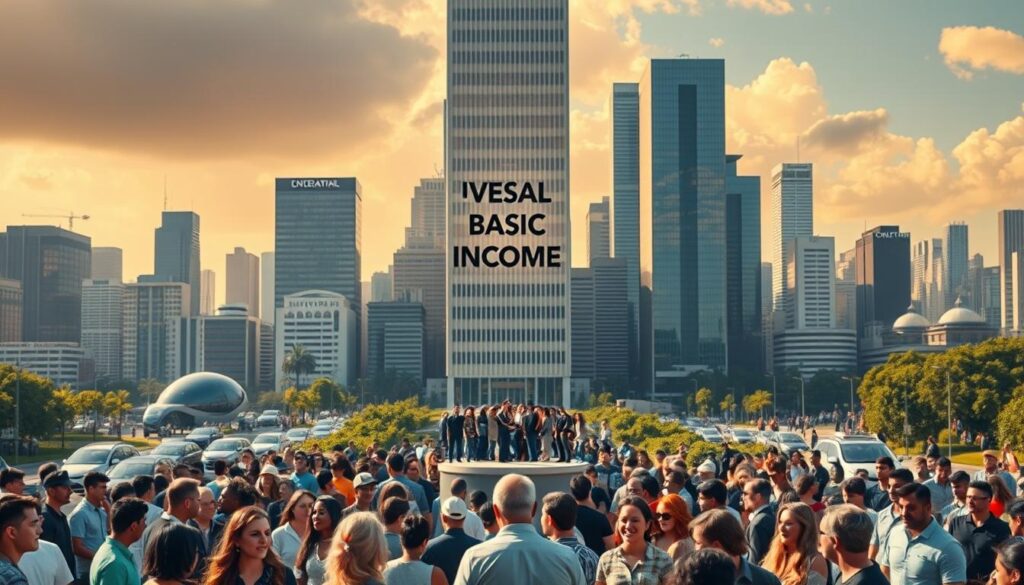
In conclusion, the case for UBI is built on its potential to address poverty, foster entrepreneurship, and simplify welfare systems. As the debate continues, it’s crucial to consider the evidence from pilot programs and economic models that support the feasibility of UBI.
Arguments Against UBI Implementation
While proponents of Universal Basic Income see it as a solution to various economic challenges, opponents highlight several potential drawbacks. The debate surrounding UBI is complex, with valid arguments on both sides.
Fiscal Sustainability Concerns
One of the primary concerns regarding UBI is its fiscal sustainability. Implementing UBI would require significant funding, potentially through increased taxes or redistribution of existing social welfare funds. Critics argue that this could lead to economic strain, particularly if the amount of UBI is substantial. For instance, a study on UBI’s economic impact suggested that implementing it could cost the United States hundreds of billions of dollars annually.
Potential Work Disincentives
Another argument against UBI is that it might disincentivize work. If people receive a basic income regardless of their employment status, some might choose not to work, potentially leading to a decrease in productivity. However, some studies suggest that the effect might be minimal, as many people continue to work for reasons beyond financial necessity, such as personal fulfillment and social interaction.
Macroeconomic Effects and Inflation Risks
Critics also point to potential macroeconomic effects, including inflation risks. Injecting a large amount of money into the economy through UBI could lead to inflation, as more money chases a constant quantity of goods and services. This could erode the purchasing power of the basic income, making it less effective in providing economic security. An study on the macroeconomic impacts of UBI highlights the need for careful consideration of its implementation to mitigate such risks.
Examining Global UBI Pilot Programs
Several countries have embarked on UBI pilot programs to assess the effectiveness of this innovative approach to social welfare. These experiments are crucial in understanding how Universal Basic Income can be implemented on a larger scale.
Notable International Experiments
Finland conducted a two-year UBI experiment from 2017 to 2019, providing 2,000 unemployed individuals with a monthly stipend of €560. The results showed improved well-being and life satisfaction among participants, although the impact on employment was minimal.
Alaska, USA, has been running a dividend program since 1982, distributing a portion of oil revenues to residents annually. This long-running program has been studied extensively and provides insights into the long-term effects of unconditional cash transfers.
Stockton, California, USA, implemented a 18-month UBI pilot called the Stockton Economic Empowerment Demonstration (SEED), providing 125 low-income residents with $500 monthly. Initial results indicated that participants were more likely to maintain full-time employment and experience reduced financial stress.
Key Outcomes and Lessons Learned
The outcomes of these global UBI pilot programs have been enlightening. Key lessons include:
- Improved well-being and life satisfaction among recipients
- Mixed results on employment, with some studies showing minimal impact and others indicating potential for increased full-time employment
- Reduced financial stress and increased financial stability
These experiments highlight the potential of UBI to enhance economic security and provide a safety net in an increasingly automated economy. As the world continues to navigate the challenges of technological disruption, the insights gained from these pilot programs will be invaluable in shaping the future of social safety nets.
American UBI Initiatives and Results
Across the U.S., a growing number of states and cities are launching their own UBI pilot programs to test the concept’s viability. These initiatives aim to provide valuable insights into the potential benefits and challenges of implementing Universal Basic Income on a larger scale.
State and Municipal Pilot Programs
Several U.S. cities and states have pioneered UBI pilot programs, each with its unique design and objectives. For instance, Stockton, California’s Economic Empowerment Demonstration (SEED) provided low-income residents with a monthly stipend of $500 for 18 months. Similarly, New York City has launched pilot programs targeting specific populations, such as artists and low-income families. These programs are crucial for understanding how UBI can be tailored to meet the needs of different communities.

Impact on Recipients and Communities
The impact of these UBI pilot programs on recipients and communities has been multifaceted. Preliminary results from various studies indicate improvements in financial stability, mental health, and even local economic activity. For example, recipients of the Stockton SEED program reported reduced stress and increased full-time employment. Moreover, the infusion of guaranteed income into local economies has shown positive effects on businesses and community development. However, challenges such as funding sustainability and potential work disincentives are also being closely examined.
As more data becomes available from these pilot programs, policymakers and researchers will be better equipped to refine UBI models, addressing both the benefits and the challenges associated with its implementation.
Economic Models for Sustainable UBI Funding
With the rise of UBI as a potential solution to economic insecurity, understanding the economic models that could support it is essential. As governments and economists explore the feasibility of UBI, several funding models have emerged, each with its advantages and challenges.
Progressive Taxation Approaches
One of the primary methods proposed for funding UBI is through progressive taxation. This involves increasing taxes on higher-income individuals and corporations to redistribute wealth. Progressive taxation can be an effective way to fund UBI by targeting those who are more financially capable of contributing to the system.
Consolidation of Existing Benefits
Another approach is to consolidate existing social welfare benefits into a single UBI system. This could streamline welfare programs and reduce administrative costs. By combining various benefits into one, governments can simplify their welfare systems and potentially reduce overall expenditure.
Innovative Funding Mechanisms
In addition to traditional taxation and benefit consolidation, several innovative funding mechanisms have been proposed. These include:
- Sovereign Wealth Funds
- Carbon Dividends
- Resource Taxes
Sovereign Wealth Funds
Sovereign wealth funds, which are state-owned investment vehicles, can be utilized to fund UBI. Countries with significant natural resources can leverage these funds to support their UBI initiatives. For instance, Alaska’s Permanent Fund Dividend has been a successful model, distributing a portion of oil revenues to residents.
Carbon Dividends and Resource Taxes
Carbon dividends, derived from carbon pricing mechanisms, and resource taxes on extractive industries, offer another potential funding stream. By placing a tax on carbon emissions or resource extraction, governments can generate revenue that can be directed towards UBI. This approach not only funds UBI but also incentivizes environmentally friendly practices.
The key to implementing UBI lies in identifying a funding model that is both sustainable and equitable. By exploring various economic models, from progressive taxation to innovative funding mechanisms, governments can work towards creating a more secure and stable social safety net for the future.
Automation, AI, and the Changing Nature of Work
The rise of automation and AI is transforming the global workforce at an unprecedented rate. As machines and algorithms become increasingly capable of performing tasks traditionally done by humans, the very nature of work is undergoing a significant transformation.
Projected Employment Disruption
Experts predict that the impact of automation on employment will be substantial. A report by the McKinsey Global Institute suggests that by 2030, up to 800 million jobs could be lost worldwide due to automation. However, it’s not all negative; the same report also highlights that while automation will displace some jobs, it will also create new ones, potentially leading to a net gain in employment opportunities. The key will be in upskilling and reskilling the workforce to adapt to new technologies.
The sectors most vulnerable to automation include manufacturing, transportation, and customer service. For instance, self-driving cars and trucks could significantly reduce the need for human drivers. On the other hand, fields like healthcare, education, and creative industries are likely to be less affected and may even see growth due to technological advancements.
UBI as an Automation Response Strategy
In the face of such significant employment disruption, Universal Basic Income (UBI) has emerged as a potential solution. Proponents argue that UBI could provide a safety net for those who lose their jobs due to automation, ensuring that everyone has a minimum standard of living. This could be particularly important in a future where traditional employment is no longer the norm.
Implementing UBI as a response to automation could have several benefits. It could help alleviate poverty and provide financial security, allowing individuals to pursue entrepreneurial ventures or creative passions without the burden of a traditional 9-to-5 job. Moreover, UBI could help stimulate local economies by putting more money in people’s pockets to spend on goods and services.
Alternative Approaches to Technological Unemployment
While UBI is one potential solution, there are other strategies that could be employed to address technological unemployment. These include retraining programs to help workers develop new skills, education reform to prepare future generations for an automated workforce, and social safety nets tailored to the needs of those displaced by technology.
Another approach is to encourage entrepreneurship and innovation, providing resources and support for individuals to start new businesses or create new products and services. This could not only help mitigate job losses but also drive economic growth and create new opportunities.
UBI and Existing Social Safety Nets
As UBI moves from theory to practice, its impact on existing welfare systems must be carefully considered. The relationship between UBI and current social safety nets is complex, involving considerations of whether UBI should supplement or replace existing programs.
Replacement vs. Complementary Models
The debate surrounding UBI’s role in relation to existing social welfare programs centers on two primary models: replacement and complementary. The replacement model suggests consolidating existing welfare programs into a single UBI system, potentially simplifying bureaucracy and reducing administrative costs. On the other hand, the complementary model proposes UBI as an additional layer of support, enhancing existing safety nets.
- Advantages of the Replacement Model:
- Simplification of welfare systems
- Potential reduction in administrative costs
- Advantages of the Complementary Model:
- Enhanced financial security for recipients
- Additional support for those in need
Transition Challenges and Considerations
Implementing UBI, whether as a replacement or complement to existing safety nets, poses significant transition challenges. These include restructuring existing welfare programs, managing potential workforce disruptions, and ensuring that the new system is adequately funded.
Key considerations for a successful transition include careful planning, stakeholder engagement, and a phased implementation approach. By understanding these challenges and considerations, policymakers can better navigate the complexities of integrating UBI with existing social safety nets.
Political and Practical Implementation Hurdles
As discussions around Universal Basic Income gain momentum, understanding the hurdles to its implementation becomes crucial. The debate around UBI is not just about its theoretical benefits or drawbacks but also about the practicalities of making it a reality.
Bipartisan Perspectives
The political landscape for UBI is complex, with both supporters and detractors across the political spectrum. Proponents argue that UBI could be a game-changer for economic security, while critics raise concerns about its feasibility and potential impact on work incentives.
A closer look at bipartisan perspectives reveals a nuanced discussion. For instance, some conservatives see UBI as a means to simplify welfare systems, while certain liberals view it as a stepping stone to more comprehensive social welfare policies.
| Bipartisan Viewpoints | Conservative Perspective | Liberal Perspective |
|---|---|---|
| UBI as Welfare Simplification | Seen as a way to consolidate and simplify existing welfare programs | Viewed with skepticism due to concerns about reducing overall welfare support |
| UBI and Economic Security | Supported for potentially reducing dependency on government aid | Advocated for as a means to ensure a basic standard of living |
Gradual Implementation Strategies
Given the complexity of implementing UBI, gradual strategies are being explored. This includes starting with pilot programs, as seen in various UBI pilot programs around the world, to test different models and funding mechanisms.
Such gradual approaches allow policymakers to assess the effectiveness and challenges of UBI in real-world settings, making adjustments as needed before scaling up.
Conclusion: Navigating the Future of Economic Security
The debate surrounding Universal Basic Income (UBI) is complex, with various perspectives on its potential to reshape social safety nets. As automation and AI continue to transform the job market, exploring UBI as a means to ensure economic security becomes increasingly relevant.
Research suggests that implementing UBI could significantly reduce poverty and improve overall well-being. For instance, a UBI at current benefit levels could decrease poverty by a quarter, while a higher level of UBI, aligned with the Minimum Income Standard, could nearly eradicate poverty. These findings are supported by trials and studies, such as those conducted in Finland and Stockton, USA, which demonstrate the positive impact of unconditional payments on recipients’ lives.
To effectively navigate the future of economic security, it is crucial to continue exploring and debating the role of UBI in an automated economy. For more information on the potential benefits and challenges of UBI, visit the Joseph Rowntree Foundation’s analysis on the topic.