
Blog
The Connected Metropolis: Using IoT, AI, and 5G to Build Sustainable and Efficient Smart Cities**


The world is becoming increasingly urbanized, with millions of people moving to cities every year. This rapid urbanization presents both opportunities and challenges for city planners and administrators. To address these challenges, the concept of smart city technology has emerged, leveraging innovative technologies like IoT, AI, and to create more sustainable, efficient, and livable urban environments.
By integrating these technologies, cities can optimize their infrastructure, reduce waste, and improve public services. For instance, IoT sensors can monitor and manage traffic flow, while AI-powered analytics can help predict and prevent crime. The use of 5G networks enables faster data transfer and communication between different city systems.
Key Takeaways
- Smart city technology involves the use of IoT, AI, and 5G to create more sustainable and efficient cities.
- These technologies can help optimize urban infrastructure and improve public services.
- The integration of IoT, AI, and 5G can lead to reduced waste and improved safety in cities.
- NVIDIA’s platforms, such as NVIDIA Omniverse and NVIDIA Metropolis, play a crucial role in enabling developers to build smart city solutions.
- The adoption of smart city technology is crucial for addressing the challenges of rapid urbanization.
The Urban Revolution: Challenges and Opportunities
The rapid urbanization trend is transforming the world’s cities, bringing with it a host of challenges and opportunities. As more people move to urban areas, cities face increasing pressure on their infrastructure, services, and resources.
Growing Urbanization and Resource Constraints
Urbanization is one of the most significant trends of the 21st century, with over 55% of the world’s population now living in cities. This number is expected to grow to 68% by 2050, according to the United Nations. Such rapid growth strains city resources, from water and energy to transportation and housing.
The challenges are multifaceted, including managing waste, reducing pollution, and ensuring public safety. Cities must also contend with aging infrastructure, which requires significant investment to upgrade and maintain.
“The world’s urban population is projected to grow by 2.5 billion by 2050, with nearly 90% of this growth happening in Asia and Africa.” – United Nations
The Need for Technological Solutions
In the face of these challenges, cities are turning to technology to create more efficient, sustainable, and livable environments. The integration of IoT, AI, and 5G technologies is at the heart of this transformation, enabling cities to become “smart.”
| Technological Solution | Urban Challenge Addressed |
|---|---|
| IoT Sensors | Efficient resource management |
| AI Analytics | Predictive maintenance and public safety |
| 5G Networks | Enhanced connectivity and data transfer |
By leveraging these technologies, cities can not only address their current challenges but also create a foundation for future growth and development. As urban planning trends continue to evolve, the role of technology in shaping sustainable and efficient cities will only become more critical.
Understanding Smart Cities: Core Concepts and Components
As urbanization continues to rise, the importance of creating smart, connected cities becomes increasingly evident. A smart city is more than just a collection of technologies; it’s a comprehensive ecosystem that integrates various components to enhance the quality of urban living.
Defining the Smart City Ecosystem
The smart city ecosystem encompasses a wide range of elements, including connected infrastructure, data analytics, and citizen engagement platforms. This ecosystem is designed to optimize resource allocation, improve public services, and foster a more sustainable environment.
Key Stakeholders in Smart Urban Development
Successful smart city initiatives involve a diverse group of stakeholders, including government agencies, private sector companies, and citizens. Each plays a crucial role in shaping the city’s technological and social landscape.
Measuring Smart City Success
To evaluate the effectiveness of smart city strategies, cities use various metrics, such as energy efficiency, traffic congestion reduction, and citizen satisfaction. These metrics help in identifying areas for improvement and in making informed decisions about future investments in connected infrastructure.
By understanding the core concepts and components of smart cities, urban planners and policymakers can better navigate the complexities of creating more sustainable, efficient, and livable urban environments.
The Technological Foundation: IoT, AI, and 5G
At the heart of smart city operations are cutting-edge technologies like IoT, AI, and 5G, transforming urban landscapes. These technologies work in tandem to create a connected, efficient, and sustainable urban environment.
IoT Sensors and Networks: The City’s Nervous System
IoT sensors and networks form the backbone of data collection in smart cities, enabling real-time monitoring of various urban systems. From traffic management to waste management, IoT devices provide critical data that informs city operations, including public services. For instance, IoT sensors can monitor air quality, detect anomalies in infrastructure, and optimize energy usage in public buildings.
Artificial Intelligence: The Brain Behind Smart Operations
AI processes the vast amounts of data generated by IoT devices, providing insights that drive decision-making in smart cities. AI algorithms can predict traffic congestion, optimize public transportation schedules, and enhance public safety through predictive policing.
5G Technology: The Communication Backbone
5G technology provides the high-speed, low-latency connectivity necessary for the seamless operation of IoT devices and AI applications. It enables real-time communication between devices, supporting advanced smart city services such as smart grids and intelligent transportation systems.
The integration of IoT, AI, and 5G technologies is revolutionizing urban development, making cities more livable, sustainable, and efficient. As these technologies continue to evolve, we can expect even more innovative applications in the realm of IoT for public services.
Smart Infrastructure and Connected Buildings
As cities evolve into smart metropolises, the focus on infrastructure and connected buildings becomes increasingly crucial. This transformation is driven by the need for more efficient, sustainable, and responsive urban environments.
Intelligent Building Management Systems
Intelligent Building Management Systems (BMS) are central to creating connected buildings. These systems integrate various technologies to monitor and control building operations, including energy usage, security, and maintenance. By optimizing these functions, BMS can significantly reduce energy consumption and operational costs.
Smart Grids and Energy Optimization
Smart grids play a vital role in energy optimization within smart cities. By leveraging advanced technologies like IoT sensors and AI, smart grids can manage energy distribution more efficiently, predict energy demand, and integrate renewable energy sources. This leads to a more reliable and sustainable energy supply.
Water and Waste Infrastructure Monitoring
Effective monitoring of water and waste infrastructure is essential for maintaining public health and environmental sustainability. IoT sensors can detect leaks, monitor water quality, and optimize waste collection routes, reducing the risk of contamination and improving overall efficiency.
| Smart Infrastructure Component | Key Benefits |
|---|---|
| Intelligent Building Management Systems | Energy efficiency, reduced operational costs |
| Smart Grids | Reliable energy supply, integration of renewables |
| Water and Waste Infrastructure Monitoring | Public health protection, environmental sustainability |
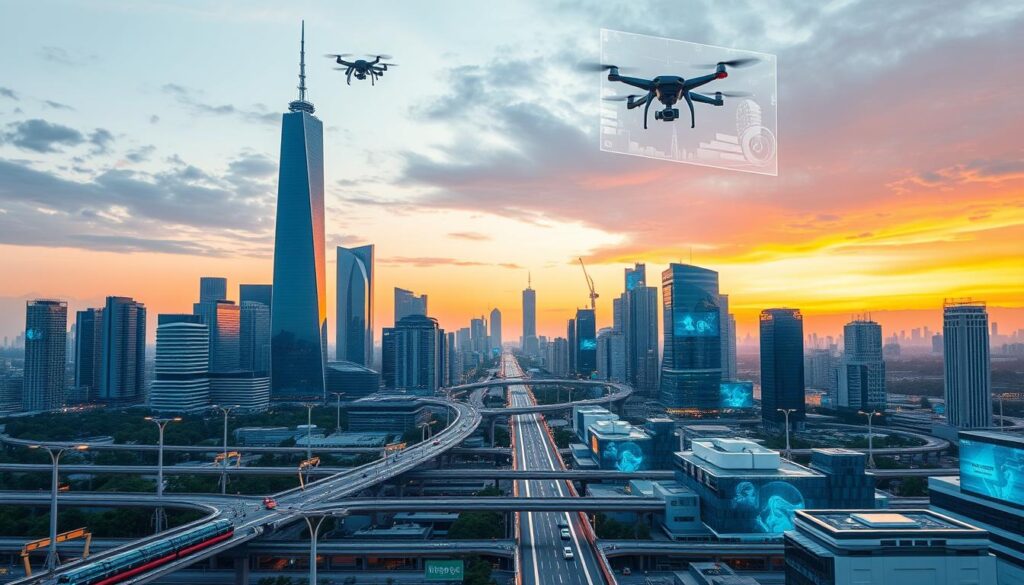
Smart Traffic Management and Urban Mobility
The future of urban transportation lies in the successful integration of technology and infrastructure to manage traffic flow effectively. As cities continue to expand, the importance of smart traffic management systems cannot be overstated.
Intelligent Transportation Systems and Traffic Flow
Intelligent Transportation Systems (ITS) utilize real-time data and advanced technologies to optimize traffic flow, reducing congestion and decreasing travel times. By implementing ITS, cities can improve road safety, enhance mobility, and provide citizens with accurate traffic information.
Connected and Autonomous Vehicles
The emergence of connected and autonomous vehicles (CAVs) is set to revolutionize urban mobility. CAVs can communicate with each other and with infrastructure, potentially reducing accidents and improving traffic efficiency. Cities are beginning to integrate CAVs into their transportation networks, paving the way for a more sustainable future.
Multimodal Transportation Solutions
Multimodal transportation solutions offer citizens a range of travel options, from public transit to bike-sharing and micromobility services. This approach not only reduces reliance on personal vehicles but also decreases congestion and environmental impact.
Bike-Sharing and Micromobility Integration
Bike-sharing and micromobility services are becoming increasingly popular, providing citizens with flexible, eco-friendly transportation options. By integrating these services into the broader transportation network, cities can enhance mobility and reduce emissions.
Public Transit Optimization
Optimizing public transit systems is crucial for efficient urban mobility. By leveraging data analytics and real-time information, cities can improve the reliability and attractiveness of public transportation, encouraging more citizens to use these services.
IoT for Public Services and Citizen Safety
Smart cities are leveraging IoT to significantly improve public services and ensure a safer environment for their citizens. By integrating advanced IoT technologies, cities can enhance their infrastructure, making it more connected and efficient.
Emergency Response and Public Safety Systems
IoT enables the development of sophisticated emergency response systems. These include smart emergency alert systems that can be triggered automatically in case of an incident, and real-time data analytics that help responders make informed decisions. For instance, IoT sensors can detect gunshots or other emergencies, alerting authorities instantly.
Smart Street Lighting and Surveillance
IoT-powered smart street lighting can adjust brightness based on the time of day and weather conditions, reducing energy consumption. Additionally, surveillance cameras equipped with IoT technology can provide real-time monitoring, enhancing public safety. These cameras can be integrated with facial recognition software to identify potential threats.
Environmental Monitoring and Disaster Management
IoT devices can monitor environmental conditions such as air quality, water quality, and weather patterns. This data is crucial for disaster management and environmental protection. For example, IoT sensors can detect early signs of floods or wildfires, enabling proactive measures to mitigate damage.
In conclusion, IoT is playing a vital role in enhancing public services and citizen safety in smart cities. By leveraging IoT technologies, cities can create a more responsive, efficient, and safe urban environment.
AI-Powered Urban Planning and Governance
Smart cities are leveraging AI to enhance urban planning, making cities more efficient and responsive. This integration is transforming various aspects of city management.
Predictive Analytics for City Management
AI-driven predictive analytics helps city managers anticipate and prepare for future challenges. By analyzing historical data and real-time inputs, cities can optimize resource allocation and infrastructure development, which can include improving smart traffic management systems.
Citizen Engagement and Digital Services
AI-powered chatbots and virtual assistants are improving citizen engagement by providing accessible and efficient digital services. These tools help residents interact with city services more easily, enhancing their overall experience.
Data-Driven Decision Making
AI enables data-driven decision making by analyzing vast amounts of data from various sources, including IoT devices and citizen feedback. This helps city officials make informed decisions that enhance urban living and improve city infrastructure.
By embracing AI in urban planning and governance, cities can become more sustainable, efficient, and responsive to the needs of their citizens, ultimately improving the quality of life for residents.
Sustainability Initiatives in Smart Cities
The integration of sustainability initiatives in smart cities is revolutionizing urban planning trends by leveraging technology to create more livable and environmentally friendly urban environments.
Renewable Energy Integration and Smart Grids
One of the key sustainability initiatives in smart cities is the integration of renewable energy sources into the grid. Smart grids enable efficient distribution and management of renewable energy, reducing reliance on fossil fuels and lowering carbon emissions. Cities are adopting innovative solutions such as:
- Solar panel installations on buildings
- Wind energy harvesting
- Energy storage systems
Climate Resilience and Adaptation Strategies
Smart cities are also focusing on climate resilience and adaptation strategies to mitigate the impacts of climate change. This includes implementing early warning systems for extreme weather events and developing green infrastructure to manage stormwater runoff. Climate resilience is becoming a critical aspect of urban planning.

Green Spaces and Urban Agriculture
Green spaces and urban agriculture are vital components of sustainable smart cities. They not only improve air quality and provide recreational areas but also contribute to food security. Cities are incorporating Smart city technology to optimize urban agriculture, such as using IoT sensors to monitor soil conditions and automate watering systems.
By embracing these sustainability initiatives, smart cities can achieve a more sustainable and resilient urban environment, enhancing the quality of life for their citizens.
Economic Benefits and Innovation Ecosystems
As cities become increasingly connected, they are unlocking significant economic benefits. The integration of advanced technologies like IoT, AI, and 5G is transforming urban landscapes into hubs of innovation and economic growth. Connected infrastructure plays a crucial role in this transformation, enabling cities to optimize resources, improve public services, and create new opportunities for businesses and residents alike.
Job Creation and New Industry Development
Smart city initiatives are driving job creation in various sectors, from technology and data analysis to sustainable energy and urban planning. The development of new industries related to smart city technologies is also contributing to economic diversification. For instance, the implementation of smart grids and energy management systems is creating new job opportunities in the renewable energy sector.
Cost Savings Through Efficiency
One of the significant economic benefits of smart cities is the cost savings achieved through increased efficiency. By leveraging data analytics and IoT sensors, cities can optimize energy consumption, reduce waste, and streamline public services. This not only leads to financial savings but also enhances the overall quality of life for residents.
Attracting Investment and Talent
Smart cities are becoming magnets for investment and top talent. The presence of advanced infrastructure and a commitment to innovation make these cities attractive to businesses, entrepreneurs, and professionals. As a result, smart cities are experiencing a surge in economic activity, driven by both domestic and foreign investment.
The economic benefits of smart cities are multifaceted, ranging from job creation and cost savings to attracting investment and talent. By continuing to invest in connected infrastructure and innovative technologies, cities can ensure sustainable economic growth and improved quality of life for their residents.
Case Studies: Leading Smart Cities in the United States
Smart city initiatives are transforming urban landscapes across America, with cities like New York, San Francisco, and Chicago leading the charge. These cities are leveraging cutting-edge technologies such as IoT, AI, and 5G to create more sustainable, efficient, and livable environments for their citizens.
New York’s Hudson Yards and LinkNYC
New York City has been at the forefront of smart city development with projects like Hudson Yards and LinkNYC. Hudson Yards is one of the largest private real estate developments in the U.S., incorporating advanced smart building technologies and infrastructure. LinkNYC, on the other hand, is a citywide initiative to replace payphones with high-speed Wi-Fi kiosks, providing free internet access to citizens and visitors.
LinkNYC has not only improved connectivity but also serves as a platform for various city services and information. As Mayor Bill de Blasio noted, “LinkNYC is a free Wi-Fi and digital platform that is revolutionizing the way New Yorkers interact with their city.”
San Francisco’s Smart City Challenge Implementation
San Francisco has been a pioneer in smart city initiatives, with a strong focus on innovative transportation solutions. The city’s Smart City Challenge implementation involves various projects aimed at improving traffic management and reducing congestion. One notable initiative is the use of IoT sensors to monitor and manage traffic flow, optimizing traffic light timings to reduce congestion.
Chicago’s Array of Things Project
Chicago’s Array of Things (AoT) project is a cutting-edge initiative that involves installing a network of sensors across the city to collect data on environmental conditions, traffic, and other urban metrics. The AoT project is a collaborative effort between the city, universities, and private sector partners.
Sensor Network Architecture
The AoT sensor network is designed to be modular and scalable, allowing for the integration of various sensors and data sources. This architecture enables the city to expand its data collection capabilities as needed.
Data Applications and Results
The data collected through the AoT project is being used to improve urban planning, optimize city services, and enhance citizen engagement. For instance, the data on environmental conditions is helping the city to develop more effective strategies for reducing pollution and improving air quality.
These case studies demonstrate the innovative approaches being taken by leading smart cities in the United States. By leveraging technologies like IoT, AI, and 5G, these cities are creating more sustainable, efficient, and livable urban environments.
“The future of cities depends on our ability to harness technology to create more livable, sustainable, and equitable environments for all citizens.” –
Overcoming Smart City Implementation Challenges
The journey to creating a smart city is fraught with challenges that need to be addressed. As cities integrate smart city technology into their infrastructure, they face numerous obstacles that can impact the success of their initiatives.
Funding and Financial Sustainability
One of the primary challenges is securing funding and ensuring financial sustainability. Smart city projects often require significant investment in infrastructure, technology, and personnel. To overcome this, cities can explore public-private partnerships, grants, and innovative financing models.
Privacy, Security, and Ethical Concerns
Another critical challenge is addressing privacy, security, and ethical concerns. As cities collect and analyze vast amounts of data, they must ensure that they are protecting citizens’ privacy and maintaining the security of their systems. Implementing robust data governance policies and cybersecurity measures is crucial.
Digital Inclusion and Accessibility
Ensuring digital inclusion and accessibility is also vital. Cities must work to bridge the digital divide and ensure that all citizens have access to the benefits of smart city technology.
Bridging the Digital Divide
Initiatives such as public Wi-Fi programs and digital literacy training can help make smart city services more accessible to all citizens.
Universal Design Principles
Applying universal design principles can also enhance accessibility. This includes designing public spaces and services that are usable by everyone, regardless of age or ability.
By addressing these challenges and leveraging urban planning trends and smart city technology, cities can create more sustainable, efficient, and livable environments for their citizens.
Conclusion: The Future of Connected Urban Environments
The integration of IoT, AI, and 5G technologies is transforming urban landscapes into sustainable, efficient, and livable smart cities. As discussed, the development of connected infrastructure is crucial in supporting these technologies and enabling cities to reap their benefits.
By leveraging smart city solutions, cities can optimize resource allocation, reduce energy consumption, and enhance the overall quality of life for their citizens. The future of urban development lies in creating connected infrastructure that can support the growing needs of urban populations.
As cities continue to evolve, it is essential to prioritize the development of sustainable and efficient connected infrastructure. This will enable cities to stay ahead of the curve and provide their citizens with a high quality of life, while also driving economic growth and innovation.