Blog
The 6G Future: How the Next-Gen Wireless Network Will Power AI and the Metaverse**


The world is on the cusp of a revolutionary change with the advent of 6G, the next generation of wireless network technology. As we transition from 5G to 6G, the potential for transformative impact on various industries, including AI and the metaverse, is vast.
This upcoming article will explore the capabilities of 6G and how it is poised to power the future of AI and the metaverse. We’ll delve into the potential applications, benefits, and the transformative impact it may have on our daily lives and various industries.
Key Takeaways
- The 6G network promises to revolutionize the way we interact with AI and the metaverse.
- Next-gen wireless technology will enable faster data transfer and lower latency.
- 6G is expected to have a significant impact on various industries, from healthcare to finance.
- The integration of 6G with AI will lead to more sophisticated applications.
- The metaverse will become more immersive and interactive with 6G technology.
The Dawn of a New Connectivity Era
With 5G still in its early stages of deployment, the telecommunications industry is already looking ahead to the next generation of wireless technology. The limitations of current 5G networks are becoming increasingly apparent as demand for faster, more reliable connectivity grows.
Current Limitations of 5G Networks
Despite its significant advancements over 4G, 5G faces challenges in meeting the ever-increasing demand for data-intensive applications. Latency, while improved, still isn’t at the level required for real-time applications like remote surgery or autonomous vehicles. Moreover, the capacity of 5G networks is being tested by the rapid proliferation of IoT devices.
| Feature | 5G Capability | Limitation |
|---|---|---|
| Peak Data Rate | 20 Gbps | Insufficient for future demands |
| Latency | 1 ms | Still too high for real-time applications |
| Connection Density | 1 million devices/km² | Struggling to keep up with IoT growth |
The Promise of Next-Generation Wireless
The advent of 6G is expected to revolutionize wireless communication with its potential to utilize the terahertz spectrum This next-generation technology promises to enable a myriad of new applications, from enhanced virtual and augmented reality experiences to widespread adoption of IoT and mission-critical communications.
As research into 6G continues, the potential benefits become clearer. With its ability to support terabit-per-second data rates and microsecond latency, 6G is poised to unlock new possibilities in fields like AI, robotics, and the Metaverse.
Understanding 6G Technology: Core Concepts and Capabilities
6G is not just an incremental upgrade; it’s a quantum leap that will redefine the boundaries of wireless communication. As we transition from 5G to 6G, we’re not just talking about faster speeds; we’re discussing a fundamental transformation in how data is transmitted, processed, and utilized.
Defining Features of 6G Networks
The defining features of 6G networks include significantly enhanced 6G network speed, ultra-low latency, and the ability to support a vast number of devices. These networks are expected to operate on the terahertz spectrum, offering unprecedented bandwidth and data transfer rates.
| Feature | 5G | 6G |
|---|---|---|
| Peak Data Rate | 20 Gbps | 1 Tbps |
| Latency | 1 ms | 0.1 ms |
| Spectrum | Sub-6 GHz, mmWave | Terahertz |
Terahertz Spectrum: Unlocking New Possibilities
The terahertz spectrum represents a new frontier in wireless communication, offering vast bandwidths that can support terabit-per-second data rates. This spectrum is crucial for applications requiring extremely high data transfer rates, such as holographic communications and advanced virtual reality experiences.
Expected Timeline for Global Implementation
While 5G is still being rolled out globally, the research and development phase for 6G has already begun. It’s expected that 6G will start being implemented around 2030, with commercial deployments potentially happening in the following decade.
The journey to 6G is not just about technological advancements; it’s also about creating a robust ecosystem that can support these new networks. This includes developing new hardware, software, and standards that can harness the full potential of 6G.
5G vs 6G: Quantifying the Generational Leap
The generational leap from 5G to 6G is marked by significant improvements in key areas. As we transition to the next generation of wireless technology, understanding these advancements is crucial for appreciating the potential of 6G.
Speed Comparison: From Gigabits to Terabits
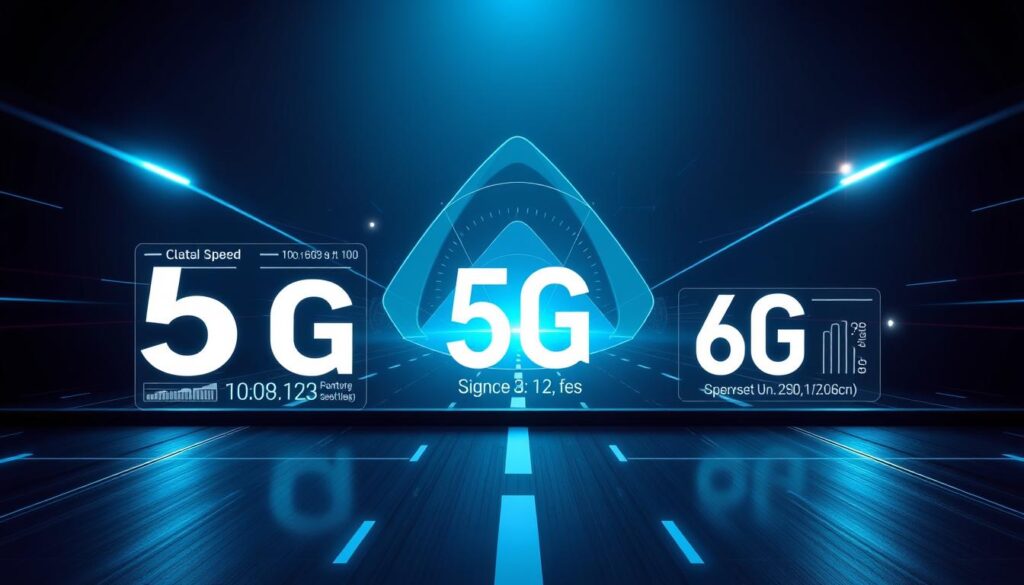
One of the most notable differences between 5G and 6G is the data transfer speed. While 5G offers peak speeds of up to 20 Gbps, 6G is expected to reach terabit-per-second speeds, significantly enhancing data-intensive applications. This leap from gigabits to terabits per second will revolutionize how we interact with data, enabling smoother and more efficient communication.
Latency Improvements: From Milliseconds to Microseconds
Latency is another critical area where 6G outperforms 5G. While 5G reduces latency to around 1 ms, 6G aims to bring it down to microseconds. This reduction is vital for real-time applications, such as remote surgery and autonomous vehicles, where even a millisecond delay can be critical.
Capacity and Connection Density Advancements
6G will also offer substantial improvements in network capacity and connection density. With the proliferation of IoT devices, 6G networks are designed to support a vast number of connections per square kilometer, far exceeding the capabilities of 5G. This increased capacity will facilitate a more interconnected world, enabling complex applications like smart cities and advanced industrial automation.
The Technical Architecture Behind 6G Networks
As we transition towards 6G, the technical architecture behind these next-generation networks becomes increasingly crucial. The infrastructure supporting 6G will be a complex interplay of advanced technologies designed to meet the demands of future wireless communication.
Cell-Free Massive MIMO and Intelligent Surfaces
One of the cornerstone technologies for 6G is cell-free massive MIMO (Multiple Input Multiple Output). This technology eliminates the traditional cell boundaries, providing a more uniform and higher quality of service across the network. Cell-free massive MIMO allows for more efficient use of spectrum and improved network capacity.
Intelligent surfaces, another key technology, can dynamically control the electromagnetic waves, enhancing signal strength and reducing interference. These surfaces can be programmed to optimize the wireless environment, making them a vital component of the 6G architecture.
Integrated Terrestrial, Airborne, and Satellite Networks
The 6G network will integrate terrestrial, airborne, and satellite networks to provide seamless and ubiquitous coverage. This integration ensures that users remain connected regardless of their location or movement. Terrestrial networks will provide high-capacity coverage in urban areas, while airborne networks will extend coverage to remote or hard-to-reach regions. Satellite networks will further enhance global connectivity, especially in areas where traditional infrastructure is lacking.
Quantum Communication Integration Possibilities
The integration of quantum communication into 6G networks holds the promise of virtually unbreakable encryption and enhanced security. Quantum communication can leverage the terahertz spectrum to achieve ultra-secure data transmission. This integration will be a significant step forward in ensuring the security and integrity of data transmitted over 6G networks.
The technical architecture of 6G networks represents a significant leap forward in wireless communication. By incorporating advanced technologies like cell-free massive MIMO, intelligent surfaces, and integrated networks, 6G will provide faster, more reliable, and more secure connectivity.
How 6G Will Transform Artificial Intelligence
The advent of 6G technology is poised to revolutionize the landscape of artificial intelligence. With its ultra-high speeds and low-latency applications, 6G will enable AI systems to become more sophisticated and responsive.
Enabling Edge AI and Distributed Intelligence
6G will significantly enhance edge AI by providing the necessary infrastructure for faster data processing and reduced latency. This will lead to more efficient and effective AI applications, particularly in scenarios requiring real-time processing.
Key benefits of edge AI with 6G include:
- Faster decision-making
- Improved security
- Enhanced user experience
AI-Native Network Design: Networks That Learn and Adapt
The integration of AI into 6G network design will create networks that can learn and adapt in real-time. This AI-native approach will optimize network performance, predict and prevent network congestion, and improve overall network reliability.
Revolutionizing Autonomous Systems and Robotics
6G’s low-latency applications will be particularly transformative for autonomous systems and robotics. By enabling real-time communication and control, 6G will enhance the capabilities of autonomous vehicles, drones, and robots, making them more reliable and efficient.
| Application | Current Limitation | 6G Enhancement |
|---|---|---|
| Autonomous Vehicles | Limited real-time control | Enhanced real-time communication |
| Industrial Robotics | Latency in command execution | Near-instant command execution |
| Drones | Restricted range and control | Extended range and precise control |
Powering the Metaverse: 6G as the Digital Backbone
6G technology is set to empower the metaverse, enabling unprecedented levels of connectivity and immersion. The metaverse, a collective virtual shared space, is expected to be a major beneficiary of the advanced capabilities offered by 6G networks.
The high-speed, low-latency characteristics of 6G will be crucial in delivering seamless and immersive experiences within the metaverse. With 6G network speed expected to reach terabits per second, the potential for rich, interactive content is vast.
Immersive XR Experiences Without Boundaries
Immersive Extended Reality (XR) experiences, including Virtual Reality (VR), Augmented Reality (AR), and Mixed Reality (MR), will be significantly enhanced by 6G. The high bandwidth and low latency of 6G will enable:
- Seamless VR/AR experiences with minimal lag
- Enhanced interactive capabilities
- More realistic and engaging virtual environments

Digital Twin Ecosystems at Global Scale
6G will support the development of digital twin ecosystems on a global scale. These digital replicas of physical entities will be able to communicate in real-time, thanks to the high-speed connectivity provided by 6G.
The benefits include:
- Improved efficiency in industrial operations
- Enhanced predictive maintenance capabilities
- Better decision-making through real-time data analysis
Holographic Communications and Telepresence
Holographic communications and telepresence will become more prevalent with 6G. The ability to project high-definition, three-dimensional images in real-time will revolutionize remote interactions.
Telepresence will allow for more immersive and engaging remote meetings and collaborations, making remote work more effective.
The integration of 6G into the metaverse will unlock new possibilities for virtual interactions, making it a critical component of the next-generation internet.
Low-Latency Applications Enabled by 6G Technology
The advent of 6G technology is poised to revolutionize various industries through its ultra-low latency capabilities. This next-generation wireless network promises to enable a wide range of applications that require real-time communication and data transfer.
Transforming Industries with Low-Latency
Remote Surgery and Healthcare Innovations
One of the most significant impacts of 6G’s low-latency will be in the healthcare sector, particularly in remote surgery. With latency reduced to microseconds, surgeons will be able to perform operations remotely with precision and accuracy, potentially saving countless lives. Robotic-assisted surgery will become more prevalent, allowing for greater flexibility and control.
Real-Time Industrial Automation and Control
6G will also revolutionize industrial automation by enabling real-time control and monitoring of machinery. This will lead to increased efficiency, reduced downtime, and improved product quality. Industries such as manufacturing and logistics will benefit greatly from the ultra-reliable and low-latency communications provided by 6G.
| Industry | Current Latency | 6G Latency | Benefits |
|---|---|---|---|
| Healthcare | 50-100 ms | <1 ms | Remote surgery, real-time monitoring |
| Manufacturing | 20-50 ms | <1 ms | Real-time automation, improved efficiency |
Tactile Internet and Haptic Feedback Systems
The tactile internet enabled by 6G will allow for the transmission of touch and haptic feedback in real-time. This will open up new possibilities for remote interactions, such as virtual reality experiences and remote training programs. The integration of haptic feedback will make these interactions more immersive and effective.
In conclusion, 6G technology will enable a wide range of low-latency applications that will transform industries and revolutionize the way we interact with technology. As 6G continues to develop, we can expect to see significant advancements in healthcare, industry, and beyond.
Connectivity Trends 2026-2030: The Path to Full 6G
As we approach 2026, the world is on the cusp of a significant shift in connectivity trends that will pave the way for full 6G implementation. The next few years will be critical in laying the groundwork for the next generation of wireless technology.
Key Milestones in 6G Development
The development of 6G is expected to gain momentum between 2026 and 2030, with several key milestones anticipated. Research and development will focus on overcoming current technological limitations, such as latency and data transfer rates. By 2028, we can expect to see the first prototypes and field trials of 6G technology, marking a significant step towards its commercialization.
Industry Transformations During the Transition Period
The transition to 6G will drive significant transformations across various industries. Telecommunications will lead the way, with companies investing heavily in infrastructure and technology. Other sectors, such as healthcare, manufacturing, and entertainment, will also undergo substantial changes as they adopt 6G-enabled solutions.
Regional Adoption Patterns and Global Standards
Regional adoption patterns will vary, with some countries leading the way in 6G adoption due to their advanced technological infrastructure. The establishment of global standards will be crucial to ensure seamless integration and interoperability across different regions. International collaborations and agreements will play a key role in shaping the future of 6G.
As stated by a leading industry expert, “The successful implementation of 6G will depend on global cooperation and the establishment of common standards.”
“The future of wireless technology is not just about faster speeds; it’s about creating a more connected and intelligent world.”
Conclusion: Preparing for the 6G Future
The advent of 6G technology is poised to revolutionize the way we interact with the world around us, transforming industries and societal norms. As discussed, 6G will significantly enhance AI capabilities, power the Metaverse, and enable low-latency applications that were previously unimaginable.
With its potential to deliver terabit speeds, ultra-low latency, and vast connection densities, 6G technology will be the backbone of future innovations. Industries such as healthcare, manufacturing, and entertainment will experience unprecedented growth and transformation.
Preparing for the 6G future requires not only technological advancements but also societal readiness. As we move towards a more connected and intelligent world, it’s crucial to address the challenges associated with 6G implementation, including infrastructure development and security concerns.
By understanding the potential of 6G technology and proactively preparing for its arrival, we can harness its power to create a more efficient, connected, and innovative world.