
Blog
The 2026 Small Business Loan Roadmap: What’s Actually Changing (and Best Rates)

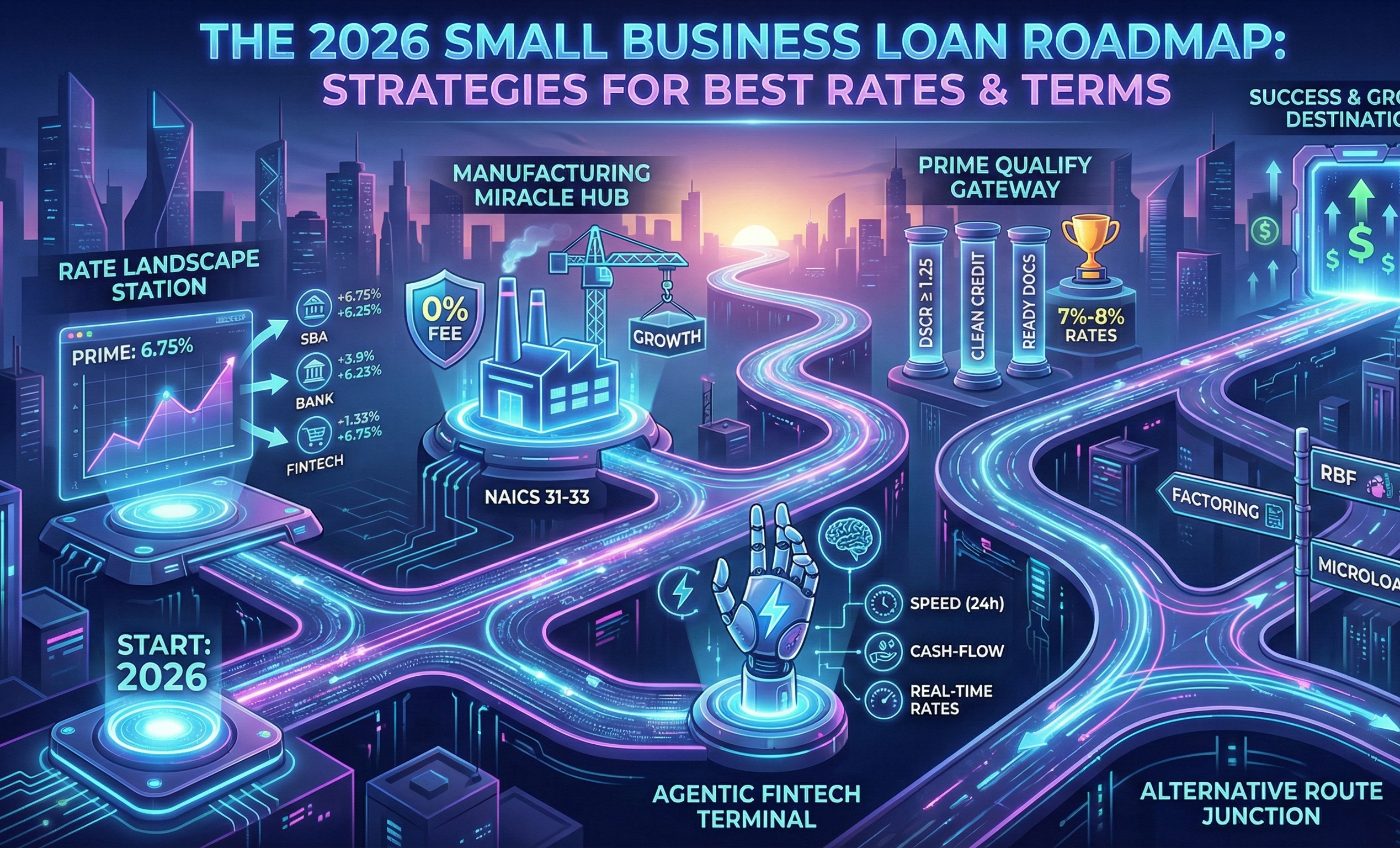
The 2026 Small Business Loan Roadmap: Strategies for Best Rates & Terms
Navigating the world of business finance as we head into 2026 feels a lot different than it did even twelve months ago. We’ve moved out of a period of rapid interest rate hikes and into a “stabilization phase.” For the savvy business owner, this means the leverage has shifted back into your hands—if you know where to look.
This guide explores the current state of SBA loans, conventional banking, and the rise of Fintech “Agentic” lending to help you secure the lowest possible cost of capital.
1. The Current Interest Rate Landscape (December 2025)
Before applying for a loan, you must understand the “Base Rates” that lenders use to build your offer. As of December 24, 2025, the Wall Street Journal Prime Rate is holding steady at 6.75% (See FRED Economic Data).
Most small business loans are “Prime +” products. This means the lender takes the base 6.75% and adds a “markup” (spread) based on your risk profile.
| Loan Category | Typical Rate Range (Late 2025) | Best For |
| SBA 7(a) Loans | 9.75% – 13.25% (Variable) | Long-term growth & working capital |
| SBA 504 (Real Estate) | 5.8% – 7.2% (Fixed) | Buying land, buildings, or heavy machinery |
| Conventional Bank Loans | 6.3% – 11.5% | Established businesses with 700+ credit |
| Business Lines of Credit | 8.0% – 11.5% | Managing seasonal cash flow gaps |
| Equipment Financing | 6.5% – 12.0% | Specific hardware or vehicle purchases |
2. The “Manufacturing Miracle”: New SBA Fee Waivers
The biggest news for the 2026 fiscal year is the SBA Fee Relief for Manufacturers. In an effort to bolster domestic production, the SBA has eliminated several significant upfront costs for businesses in NAICS sectors 31–33.
What is changing?
-
7(a) Loans under $950,000: The upfront guaranty fee is now 0% for manufacturers. Previously, this fee could cost a business owner $20,000 to $30,000 at the closing table.
-
504 Loans: Both the upfront guaranty fee and the annual service fee have been waived for manufacturing projects. This significantly lowers the effective APR for purchasing factories or heavy machinery.
-
MARC Loans: The new “Manufacturers’ Access to Revolving Credit” (MARC) program officially launched on October 1, 2025. This 7(a) program provides dedicated revolving lines of credit up to $5 million specifically for factory operations and supply chain reshoring.
3. The Rise of “Agentic” Fintech Lending
2025 was the year AI became “Agentic”—meaning AI doesn’t just suggest things; it does things. This has hit the lending world hard.
Modern lenders like Bluevine, Lendio, and Fundbox have moved beyond basic algorithms to API-based Agentic Underwriting. When you apply, you connect your QuickBooks, your bank account (via Plaid), and your Stripe/Shopify store. The “Agent” then actively monitors your cash flow health to approve funding.
Why this helps you:
-
Speed: You can get a binding “Offer” in 4 minutes and “Funding” in 24 hours.
-
Cash-Flow Over Collateral: If you have high revenue but low collateral, these lenders are more likely to approve you than a traditional “Big Box” bank.
-
Dynamic Rate Adjustments: Some 2026 loan products feature “Performance-Based” rate drops. If your revenue grows 20% over six months, the AI agent can automatically trigger a rate reduction on your outstanding balance.
4. Real-World Scenarios: Who Gets Funded?
To help you visualize where you fit, here are three scenarios based on current market conditions.
Case Study A: The Manufacturer (SBA 7(a) MARC)
-
Business: “Apex Metalworks” (NAICS 332)
-
Need: $800,000 for raw materials and a new CNC machine.
-
Old Terms (2024): Rate of 11.5% + $22,000 upfront guaranty fee.
-
New Terms (2026): Rate of 10.5% + $0 upfront fee.
-
Result: Apex saves $22k immediately and uses the MARC program to draw funds only when buying steel, minimizing interest costs.
Case Study B: The E-Commerce Brand (Agentic Fintech)
-
Business: “Glow Skincare” (Shopify Store)
-
Need: $50,000 for holiday inventory.
-
Challenge: No physical assets (real estate) to pledge as collateral.
-
Solution: Applied via a Fintech lender. The AI agent analyzed 12 months of Stripe sales data.
-
Outcome: Approved in 2 hours for a Revenue-Based Financing deal. They repay 10% of daily sales until the $50k + fee is paid. No fixed monthly payment meant less stress during slow weeks.
Case Study C: The Established Service Firm (Conventional Bank)
-
Business: “Elite HVAC Services” (10 years in business)
-
Need: $1.2 Million to buy a competitor.
-
Profile: 780 FICO, DSCR of 1.65.
-
Outcome: Skipped the SBA entirely. Secured a conventional bank loan at Prime + 0.5% (7.25%).
-
Lesson: If your financials are pristine, conventional bank rates often beat SBA rates because you avoid the higher “variable” margins.
5. How to Qualify for the Best “Prime” Rates
Lenders in 2026 are looking for three specific “pillars” of health. If you can prove these, you move from a 13% interest rate down to a 7% or 8% rate.
Pillar 1: Debt Service Coverage Ratio (DSCR)
Lenders want to see a DSCR of 1.25 or higher.
The Formula:
DSCR = Net Operating Income / Total Debt Service
If your business makes $125,000 in profit and your total annual loan payments are $100,000, your ratio is 1.25. Below 1.0, you are “bleeding cash” and will face higher “Risk Premiums.”
Pillar 2: The “Clean” Credit Profile
In 2026, the FICO SBSS (Small Business Scoring Service) score is paramount. It pulls from both your personal credit and your business credit (Dun & Bradstreet/Experian Business).
-
Tip: Ensure your business has its own “trade lines.” Ask suppliers to report on-time payments.
Pillar 3: Documentation Readiness
The #1 reason loans get delayed is “Messy Books.”
-
Year-to-Date (YTD) P&L: Must be no more than 30 days old.
-
Balance Sheet: Must show clear asset-to-liability ratios.
-
Tax Returns: Have the last three years ready in a single, searchable PDF.
6. Summary: Your 3-Step Action Plan
-
Check your NAICS code: If you are in manufacturing (31-33), apply for the SBA fee-waived programs before September 30, 2026.
-
Run your DSCR: Use the formula above. If you’re under 1.25, focus on reducing expenses or increasing margins for three months before applying.
-
Shop “Fintech” and “Traditional” simultaneously: Use a marketplace to get a Fintech offer in hand, then take that offer to your local bank and ask them to beat the rate.
Lending in 2026 is about data transparency. The more clearly you can show your cash flow, the less you will pay for the “privilege” of borrowing.